
MAX5464ESA vs CAT5114VI-50
| Part Number |
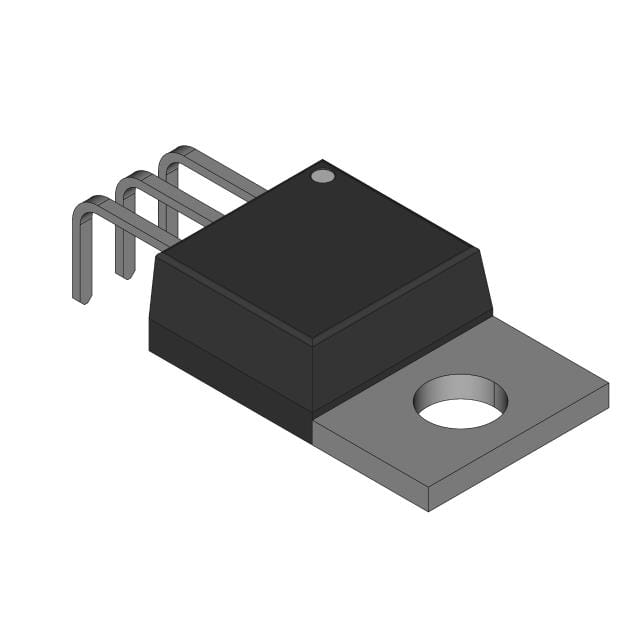
|
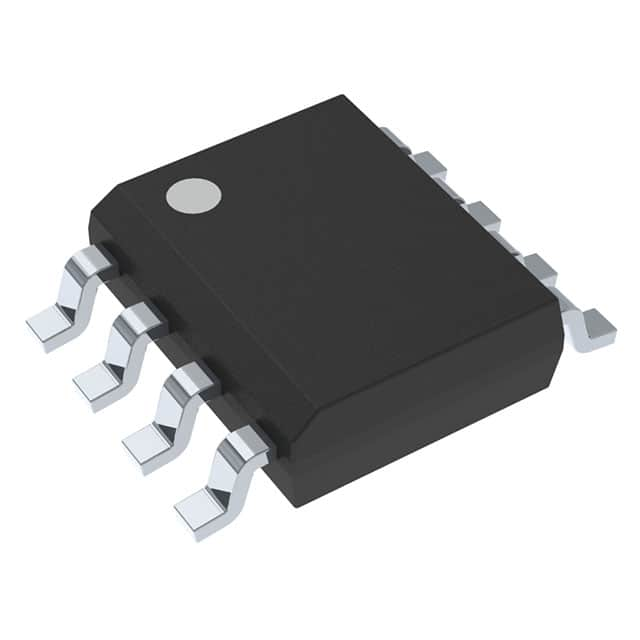
|
| Category | Digital Potentiometers ICs | Digital Potentiometers ICs |
| Manufacturer | Maxim Integrated | Catalyst Semiconductor Inc. |
| Description | 32-TAP FLEAPOT, 2-WIRE DIGITAL P | DIGITAL POT, 1 FUNC, 50000OHM, I |
| Package | Bulk | Bulk |
| Series | - | - |
| Features | - | - |
| Interface | - | Up/Down (U/D, INC, CS) |
| Voltage - Supply | - | 2.5V ~ 6V |
| Operating Temperature | - | -40°C ~ 85°C |
| Mounting Type | - | Surface Mount |
| Package / Case | - | 8-SOIC (0.154\", 3.90mm Width) |
| Supplier Device Package | - | 8-SOIC |
| Tolerance | - | ±20% |
| Number of Circuits | - | 1 |
| Configuration | - | Potentiometer |
| Memory Type | - | Non-Volatile |
| Taper | - | Linear |
| Number of Taps | - | 32 |
| Resistance (Ohms) | - | 50k |
| Temperature Coefficient (Typ) | - | 300ppm/°C |
| Resistance - Wiper (Ohms) (Typ) | - | 150 |

-
1. What is a digital potentiometer IC?
A digital potentiometer IC is a new type of CMOS digital and analog mixed signal processing integrated circuit that generates an analog output through digital input control and can replace traditional mechanical potentiometers. Digital potentiometers are also called programmable resistors or digitally controlled programmable resistors. They achieve circuit adjustment through CPU digital communication without the need to build a complex circuit environment.
Digital potentiometer ICs have many unique features and advantages. First, they do not require a wiper, making them more rugged and reliable. Second, digital potentiometers can be controlled, set, and change resistance values or voltage divider ratios through processors and software, providing flexibility and precision that mechanical devices cannot match. In addition, digital potentiometers can also be remotely adjusted through firmware to meet the requirements of high reliability and precise control.
There are several factors to consider when selecting a digital potentiometer IC. First, select the number of potentiometers and the number of sliders based on application requirements. Second, consider the resistance value of the resistor and whether there is a buffer contact. Finally, you also need to consider the packaging form and whether you need to remember the position when power is off. -
2. What are the components of a digital potentiometer?
A digital potentiometer mainly consists of two parts: a voltage divider and a controller.
The voltage divider consists of a series of resistor elements that divide the input voltage according to a certain ratio. Each resistor element is connected to the input pin of the controller. The controller is responsible for reading the control signal and opening or closing the corresponding switch according to the level of the signal, thereby changing the total resistance. -
3. What is the difference between potentiometers and digital potentiometers?
The main difference between potentiometers and digital potentiometers is their working principle, structure and application scenarios.
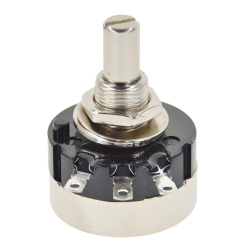
Potentiometer is a traditional electronic component that adjusts the resistance value mechanically. Potentiometers usually consist of a resistor and a movable brush. When the brush moves on the resistor, the resistance value can be changed, thereby adjusting the current or voltage in the circuit. The structure of the potentiometer is relatively simple. It mainly consists of a resistor and a rotating or sliding system. The resistance value is changed by manually adjusting the shaft or slider.
Digital potentiometer is a programmable electronic component that controls the resistance value through digital signals. It consists of a register unit and a digital isolator. The digital isolator can be a matrix, tree or serial type. Digital potentiometers do not require mechanical contacts and control the resistance value through a microprocessor and digital signals. They have high precision and flexibility. Digital potentiometers are more accurate and reliable when adjusting circuit parameters and are not easily affected by wear or environment. -
4. How to use digital potentiometers?
Digital potentiometers are a new type of CMOS digital and analog mixed signal processing integrated circuit that replaces traditional mechanical potentiometers. It is controlled by digital inputs, produces an analog output, and has precise resistance adjustment functions.
The basic components of digital potentiometers include voltage dividers and controllers. The voltage divider consists of a series of resistor elements that divide the input voltage according to a certain ratio; the controller is responsible for reading the control signal and opening or closing the corresponding switch according to the high or low signal, thereby changing the size of the total resistance.
When using a digital potentiometer, you first need to make a hardware connection. For example, connect the encoding mode of the EC11 digital potentiometer to a specific pin of the timer. Then, the mode of the encoder is controlled by software to adjust the digital potentiometer. The specific operations include entering the potentiometer mode, adjusting the value, and saving the setting.
