
RN55C1401BB14 vs RN55C2370BB14
| Part Number |

|

|
| Category | Through Hole Resistors | Through Hole Resistors |
| Manufacturer | Vishay Dale | Vishay Dale |
| Description | RES 1.4K OHM 1/8W .1% AXIAL | RES 237 OHM 1/8W .1% AXIAL |
| Package | Bulk | Bulk |
| Series | Military, MIL-R-10509/7, RN55 | Military, MIL-R-10509/7, RN55 |
| Features | Flame Retardant Coating, Military, Moisture Resistant, Safety | Flame Retardant Coating, Military, Moisture Resistant, Safety |
| Operating Temperature | -65°C ~ 175°C | -65°C ~ 175°C |
| Package / Case | Axial | Axial |
| Supplier Device Package | Axial | Axial |
| Tolerance | ±0.1% | ±0.1% |
| Temperature Coefficient | ±50ppm/°C | ±50ppm/°C |
| Size / Dimension | 0.090" Dia x 0.240" L (2.29mm x 6.10mm) | 0.090" Dia x 0.240" L (2.29mm x 6.10mm) |
| Power (Watts) | 0.125W, 1/8W | 0.125W, 1/8W |
| Height - Seated (Max) | - | - |
| Failure Rate | - | - |
| Resistance | 1.4 kOhms | 237 Ohms |
| Composition | Metal Film | Metal Film |
| Number of Terminations | 2 | 2 |

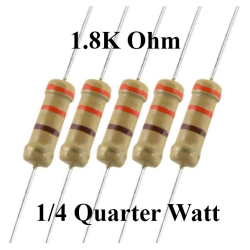
-
1. Resistor parameters
Through-hole resistor 10k/0.25w parameters
The parameters of the through-hole resistor 10k/0.25w include nominal resistance 10KΩ, rated power 0.25W, accuracy 1%, and installation type is through-hole.
Nominal resistance: 10KΩ, indicating that the basic resistance of the resistor is 10,000 ohms.
Rated power: 0.25W, meaning that the maximum power the resistor can withstand continuously is 0.25 watts.
Accuracy: 1%, indicating that the deviation between the actual resistance of the resistor and the nominal resistance does not exceed 1%.
Mounting type: through-hole, indicating that this resistor is suitable for through-hole installation, usually for through-hole installation on circuit boards. -
2. What are the advantages of through-hole resistors?
Strong component connection: Through-hole technology passes through the circuit board through physical leads and is soldered on the other side, forming a strong connection that can resist mechanical stress. This makes through-hole resistors an excellent choice for components that are subject to physical strain, such as connectors, switches, or large, heavy components.
Reliable performance at high temperatures: Through-hole components are generally more resistant to extreme thermal environments, which is beneficial for applications that operate in high-temperature environments or undergo significant thermal cycles.
Easy to prototype and debug: Through-hole components are generally easier to use for manual assembly, prototyping, or testing. They can be manually inserted and soldered, making it easy to debug or modify prototypes.
Enhanced testability: Circuit boards designed with through-hole designs inherently provide excellent testability. The lead ends of the devices in the through-hole board also act as test nodes, which enables efficient online testing because the test probes can easily access them from the bottom. This makes it easier and more efficient to diagnose and fix any potential problems. -
3. What are the classifications of through-hole resistors?
1. Unidirectional through-hole resistors
Unidirectional through-hole resistors are one of the simplest through-hole resistors. It has only one through-hole aperture, and current can only enter and flow through the resistor body in one direction. Unidirectional through-hole resistors are characterized by simple structure and low manufacturing cost.
2. Bidirectional through-hole resistors
Bidirectional through-hole resistors have the characteristics of bidirectional current flow and can be used as voltage dividers, RC couplers, inductive couplers, etc. It has a bidirectional cutting process and requires higher precision and technical requirements during the manufacturing process.
3. Multi-circular hole resistors
Multi-circular hole resistors are a type of multi-hole through-hole resistor with higher power carrying capacity and lower inductance value. It is suitable for use in high frequency and high temperature environments, such as power supplies and switching circuits.
4. Multi-rectangular through-hole resistors
Multi-rectangular through-hole resistors have multiple rectangular through-hole apertures and can be used in the manufacture of high-power devices. It has stronger resistance to mechanical stress and better heat dissipation performance, and can be used in power tools, aerospace and other fields. -
4. What are the applications of through-hole resistors?
Voltage division: The required voltage is distributed through series resistors. It is often used for voltage sampling and current sampling. It is connected in series through precision resistors with small resistance. After voltage division, the voltage needs to be amplified by an amplifier.
Shunting: When the current in the loop is large and the power of one resistor is insufficient, the current is shunted through parallel resistors to play a protective role.
Current limiting: Limit the current passing through components to protect components, such as the current limiting resistor of LED light-emitting diodes.
Decoupling: In circuit operation, resistors are used to form a path to remove excess energy, which is used for inductive components.
Filtering: Together with capacitors, a filter circuit is formed. The cutoff frequency of the filter is calculated according to the resistance value and the capacitance value to achieve low-pass filtering or high-pass filtering.
Pull-up and pull-down: The pull-up resistor is connected to the positive end of the power supply, and the pull-down resistor is connected to the negative end of the power supply. It is used for signal output or input to prevent false operation caused by signal interference.
Dummy load: Connect a resistor in parallel with the output end of the power supply so that the output end does not form an empty load, which clamps the output voltage.
Jumper function: Mainly the use of 0 ohm resistors, used for debugging and compatibility, convenient wiring, reserved resistor positions, convenient current testing, noise suppression, safety protection and other occasions.
