
RN55C1450BB14 vs RN55C1401DB14
| Part Number |

|

|
| Category | Through Hole Resistors | Through Hole Resistors |
| Manufacturer | Vishay Dale | Vishay Dale |
| Description | RES 145 OHM 1/8W .1% AXIAL | RES 1.4K OHM 1/8W .5% AXIAL |
| Package | Bulk | Bulk |
| Series | Military, MIL-R-10509/7, RN55 | Military, MIL-R-10509/7, RN55 |
| Features | Flame Retardant Coating, Military, Moisture Resistant, Safety | Flame Retardant Coating, Military, Moisture Resistant, Safety |
| Operating Temperature | -65°C ~ 175°C | -65°C ~ 175°C |
| Package / Case | Axial | Axial |
| Supplier Device Package | Axial | Axial |
| Tolerance | ±0.1% | ±0.5% |
| Temperature Coefficient | ±50ppm/°C | ±50ppm/°C |
| Size / Dimension | 0.090" Dia x 0.240" L (2.29mm x 6.10mm) | 0.090" Dia x 0.240" L (2.29mm x 6.10mm) |
| Power (Watts) | 0.125W, 1/8W | 0.125W, 1/8W |
| Height - Seated (Max) | - | - |
| Failure Rate | - | - |
| Resistance | 145 Ohms | 1.4 kOhms |
| Composition | Metal Film | Metal Film |
| Number of Terminations | 2 | 2 |

-
1. Resistor parameter marking
1. Direct marking method: directly mark the resistance value and allowable deviation of the resistor on the surface of the resistor. For chip resistors, 3-digit Arabic numerals are usually used to mark the resistance value, where the first digit represents the first significant digit of the resistance value, the second digit represents the second significant digit of the resistance value, and the third digit represents the multiple of the resistance value (that is, the number of 0s). For example, 203 represents 20kΩ, 471 represents 470Ω, and 105 represents 1MQ. For decimal ohms or integer values within 10Ω, specific symbols are also used, such as 1R2 represents 1.2Ω.
2. Text symbol method: Use three digits to mark the resistance value of the resistor, and no longer indicate the accuracy level (generally less than ±5%). This method is suitable for miniaturized electronic components, especially surface mount components and devices. For example, 3R9 represents 3.9Ω.
3. Digital method: Use three digits to represent the nominal value on the resistor, where the first and second digits are the effective value, and the third digit is the index (that is, the number of 0s), in ohms. Deviations are usually represented by text symbols.
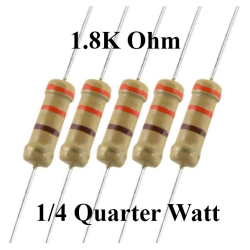
4. Color code method: Use different colored strips or dots to mark the nominal resistance value and allowable deviation on the surface of the resistor. This method is more common in foreign resistors. There is a fixed correspondence between color and value, such as black represents 0, brown represents 1, red represents 2, and so on. -
2. Resistor parameters
Through-hole resistor 10k/0.25w parameters
The parameters of the through-hole resistor 10k/0.25w include nominal resistance 10KΩ, rated power 0.25W, accuracy 1%, and installation type is through-hole.
Nominal resistance: 10KΩ, indicating that the basic resistance of the resistor is 10,000 ohms.
Rated power: 0.25W, meaning that the maximum power the resistor can withstand continuously is 0.25 watts.
Accuracy: 1%, indicating that the deviation between the actual resistance of the resistor and the nominal resistance does not exceed 1%.
Mounting type: through-hole, indicating that this resistor is suitable for through-hole installation, usually for through-hole installation on circuit boards. -
3. What are the classifications of through-hole resistors?
1. Unidirectional through-hole resistors
Unidirectional through-hole resistors are one of the simplest through-hole resistors. It has only one through-hole aperture, and current can only enter and flow through the resistor body in one direction. Unidirectional through-hole resistors are characterized by simple structure and low manufacturing cost.
2. Bidirectional through-hole resistors
Bidirectional through-hole resistors have the characteristics of bidirectional current flow and can be used as voltage dividers, RC couplers, inductive couplers, etc. It has a bidirectional cutting process and requires higher precision and technical requirements during the manufacturing process.
3. Multi-circular hole resistors
Multi-circular hole resistors are a type of multi-hole through-hole resistor with higher power carrying capacity and lower inductance value. It is suitable for use in high frequency and high temperature environments, such as power supplies and switching circuits.
4. Multi-rectangular through-hole resistors
Multi-rectangular through-hole resistors have multiple rectangular through-hole apertures and can be used in the manufacture of high-power devices. It has stronger resistance to mechanical stress and better heat dissipation performance, and can be used in power tools, aerospace and other fields. -
4. Definition and function of through-hole resistors
A through-hole resistor is a resistor device that can fix the resistor body and wire by perforating holes to achieve the purpose of fixing and conducting current. Through-hole resistors are widely used in various circuits, such as power amplifiers, digital circuits, analog signal processors, etc.
