
TA33-56K2F vs TA33-140RFD
| Part Number |

|

|
| Category | Resistor Networks, Arrays | Resistor Networks, Arrays |
| Manufacturer | Vishay Sfernice | Vishay Sfernice |
| Description | SFERNICE THIN FILMS | SFERNICE THIN FILMS |
| Package | Tray | Tray |
| Series | - | - |
| Operating Temperature | - | - |
| Mounting Type | - | - |
| Package / Case | - | - |
| Supplier Device Package | - | - |
| Applications | - | - |
| Tolerance | - | - |
| Temperature Coefficient | - | - |
| Size / Dimension | - | - |
| Resistance (Ohms) | - | - |
| Height - Seated (Max) | - | - |
| Circuit Type | - | - |
| Number of Resistors | - | - |
| Number of Pins | - | - |
| Power Per Element | - | - |
| Resistor Matching Ratio | - | - |
| Resistor-Ratio-Drift | - | - |
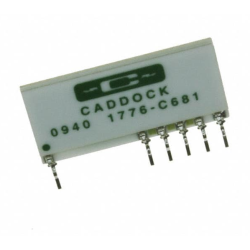
-
1. What is a resistor array?
Array structure composed of multiple resistors
Resistor array refers to a structure formed by combining multiple resistors in a certain arrangement. This structure is widely used in electronic circuits and is mainly used to realize specific circuit functions, such as voltage division, filtering, impedance matching, etc.
Basic composition and types of resistor arrays
Resistor arrays are usually composed of multiple resistors, which can be arranged in one or two dimensions. According to the arrangement method and application requirements, resistor arrays can be divided into the following types:
One-dimensional resistor array: resistors are arranged in a straight line or curve, which is suitable for occasions where linear distributed resistors are required.
Two-dimensional resistor array: resistors are arranged in a matrix form in a plane, which is suitable for occasions where complex distributed resistors are required.
Application of resistor arrays in electronic circuits
Resistor arrays have many applications in electronic circuits, mainly including:
Voltage divider: voltage division can be achieved through resistor arrays, which are often used for signal conditioning and voltage reference.
Filter: By combining resistor arrays with capacitors, low-pass, high-pass or band-pass filters can be formed for signal processing.
Impedance matching: In high-frequency circuits, resistor arrays are often used to achieve impedance matching to ensure smooth signal transmission.
Op amp feedback circuit: In operational amplifiers, resistor arrays are used to form feedback loops, which affect the performance of the amplifier.
-
2. What is the resistance of a resistor network?
Basic concepts and calculation methods of resistor networks
A resistor network is a circuit composed of resistor elements connected in a certain way. Calculating the resistance value of a resistor network usually requires the application of Kirchhoff's law and Ohm's law. Kirchhoff's law includes the current law and the voltage law, which help us analyze the relationship between current and voltage in a circuit. Ohm's law describes the relationship between resistance, voltage, and current.
Specific resistance network resistance calculation example
Cube resistance network: In a cube network consisting of 12 10kΩ resistors, if all resistors are the same and voltage is applied across A and H, then the resistance between A-H is three-quarters of a single resistor, that is, 7.5kΩ.
Infinite resistance network: For an infinite resistance network, the calculation of its equivalent resistance requires the use of the concepts of parallel and series connection. Let the equivalent resistance be Req, which can be solved by equating the infinite network to a Req, then connecting it in parallel with a 1Ω resistor, and then in series, and finally solving it through a mathematical expression.
-
3. What is an array in a circuit?
Types of arrays
Gate array: The gate array is a motherboard with basic logic gates formed on the silicon wafer provided by semiconductor manufacturers. Users can wire on the motherboard according to their needs to form the required circuit. This chip is semi-customized and is suitable for occasions that require specific functions.
PLA (Programmable Logic Array): PLA is a variant of ROM. Its storage unit body and address decoder are both user-programmable. It is suitable for occasions that require flexible configuration of logic functions.
PAL (Programmable Array Logic): PAL is also a variant of ROM. Its storage unit body is not programmable, but the address decoder is user-programmable. It is suitable for occasions that require partial programmable logic.
GAL (General Array Logic): GAL is more powerful than PLA and PAL, and is suitable for occasions that require more complex logic functions.
PGA (Programmable Gate Array): PGA is an array logic circuit with strong logic functions. Users can interconnect the gate circuits in the gate array as needed to achieve the required logic functions.
PMA (Programmable Macrocell Array): PMA is more powerful than PGA and has a higher degree of integration. It is suitable for occasions that require higher performance and complex logic.
PLD (Programmable Logic Device): PLD is a collective name for array logic circuits other than RAM, and is suitable for occasions that require flexible configuration of logic functions.
-
4. Does the resistor network have polarity?
Resistor networks do not have polarity. Resistors themselves have no polarity. Whether they are fixed resistors, adjustable resistors or various sensitive resistors, there is no distinction between positive and negative poles. The main difference between resistors lies in the difference in resistance value and packaging, not polarity.
In a resistor network, the way the resistors are connected determines the behavior of the circuit.
