
DDSC2R5LGN242K54BS vs JJD0E138MSEDBN
| Part Number |
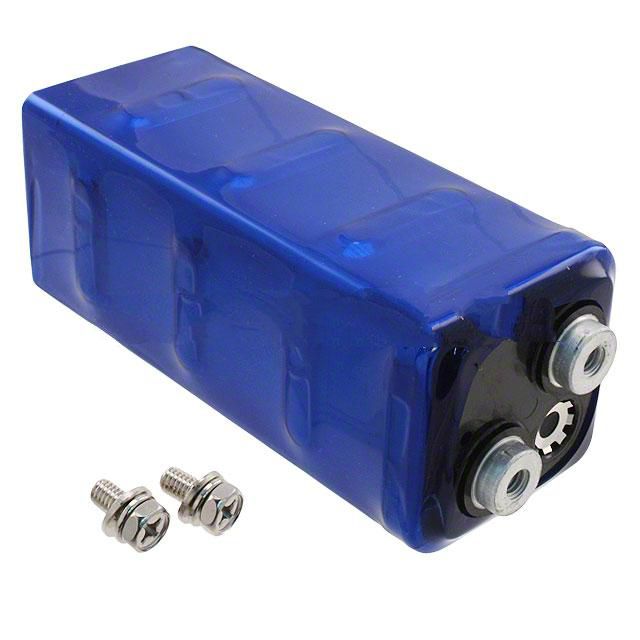
|

|
| Category | Electric Double Layer Capacitors (EDLC), Supercapacitors | Electric Double Layer Capacitors (EDLC), Supercapacitors |
| Manufacturer | United Chemi-Con | Nichicon |
| Description | CAP 2400F 10% 2.5V CHASSIS MOUNT | CAP 1300F 20% 2.5V CHASSIS MOUNT |
| Package | Cut Tape (CT) | Bulk |
| Series | DLCAP™, DSC | EVerCAP® JJD |
| Operating Temperature | -25°C ~ 60°C | -25°C ~ 60°C |
| Mounting Type | Chassis Mount | Chassis Mount |
| Package / Case | Radial, Can - Screw Terminals | Radial, Can - Screw Terminals |
| Tolerance | ±10% | ±20% |
| Size / Dimension | 2.126" L x 2.126" W (54.00mm x 54.00mm) | 1.575\" Dia (40.00mm) |
| Termination | Screw Terminals | Screw Terminals |
| Voltage - Rated | 2.5 V | 2.5 V |
| Lead Spacing | 1.069\" (27.15mm) | 0.740\" (18.80mm) |
| Height - Seated (Max) | 5.079\" (129.00mm) | 5.433\" (138.00mm) |
| Capacitance | 2400 F | 1300 F |
| ESR (Equivalent Series Resistance) | 0.7mOhm | 6mOhm |
| Lifetime @ Temp. | 2000 Hrs @ 60°C | 2000 Hrs @ 60°C |

-
1. What is an edl capacitor?
An EDL capacitor, also known as a supercapacitor, is a device that rapidly stores and releases energy through physical adsorption and desorption of ions in an electrolyte between electrodes. Its basic structure consists of electrodes coated in a porous material, usually a carbon-based material, separated by an electrolyte, which itself is separated by a membrane.
Working Principle
The working principle of an EDL capacitor is based on the double layer effect. When two different solid and liquid phases come into contact, positive and negative charges are distributed over a short distance at the interface, forming a double layer. The charge layer along this boundary surface stores energy, similar to how conventional capacitors store energy. Advances in modern carbon-based materials have enabled porous electrodes to have large surface areas, resulting in high capacitance density and small physical form factors. -
2. What is the difference between an EDLC and a supercapacitor?
There are some differences between EDLC (Electrochemical Double Layer Capacitor) and supercapacitors in terms of definition, working principle, and application scenarios.
Definition and Basic Concepts
EDLC: EDLC is a capacitor that uses the electrochemical double layer effect to store electrical energy. It stores charge by forming a double electric layer on the electrode surface and has the characteristics of high specific capacitance and fast charging and discharging.
Supercapacitor: Supercapacitor usually refers to EDLC, which is an electrochemical element that stores energy by polarizing electrolytes and has the characteristics of high power density and long cycle life.
Working Principle
EDLC: The working principle of EDLC is based on the electrochemical double layer theory, which stores charge by forming a double electric layer on the electrode surface. This structure enables EDLC to complete the charging and discharging process in a very short time and has a high energy density.
Supercapacitor: The energy storage mechanism of supercapacitor is the same as that of EDLC, which uses the electrochemical double layer effect to store electrical energy. Its working principle is to store and release charge by polarizing electrolytes. -
3. How does EDLC supercapacitor work?
Electric double layer capacitor (EDLC), also known as supercapacitor, is an electrochemical energy storage device with high energy density and fast charging and discharging capabilities. Its core principle is based on the double-layer effect formed at the interface between the electrode and the electrolyte, and energy storage is achieved through the adsorption and desorption of ions. Compared with traditional batteries, EDLC performs better in power density, cycle life and temperature adaptability, so it is widely used in transportation, renewable energy and other fields. The following is an analysis of technical characteristics, market status, application scenarios and development trends.
Technical characteristics and working principles
EDLC uses the double-layer structure between the electrode (usually a porous carbon material) and the electrolyte to store charge. When charging, the ions in the electrolyte are adsorbed on the electrode surface under the action of the electric field; when discharging, the ions leave the electrode and return to the electrolyte. This physical energy storage mechanism gives it the following advantages:
High power density: charging and discharging can be completed within seconds, and the power density can reach several kilowatts/kilogram, far exceeding lithium-ion batteries.
Long cycle life: the number of charge and discharge times can reach hundreds of thousands, which is much higher than the hundreds to thousands of times of batteries.
Wide temperature adaptability: The operating temperature range is usually between -40℃ and 70℃, suitable for extreme environments.
-
4. What is the double layer in supercapacitors?
The double layer in supercapacitor refers to the situation that when a conductive electrode (such as porous activated carbon material) is immersed in an electrolyte solution, the electrode surface and the liquid interface will form excess charges of opposite signs due to uneven charge distribution on both sides, thereby generating a potential difference between the interfaces. This phenomenon is the basis for the formation of the double layer. Specifically, the double layer consists of an inner Helm layer (a compact adsorption layer close to the electrode surface) and a diffusion layer (an ion distribution layer close to the electrolyte side).
The formation process of the double layer
Uneven charge distribution: When a conductive electrode is immersed in an electrolyte solution, the electrode surface and the liquid interface will form excess charges of opposite signs due to uneven charge distribution on both sides.
Electric field action: Under the action of the electric field, the positive and negative ions in the electrolyte will quickly move to the electrode surface, forming a compact charge layer at the positive and negative electrodes, namely the double layer.
Charge accumulation: The formation of the double layer depends on the electron enrichment on the electrode surface and the redistribution of ions in the electrolyte, and energy storage is achieved through the accumulation of interfacial charges.
