
031-6121 vs 531-40078-1
| Part Number |

|
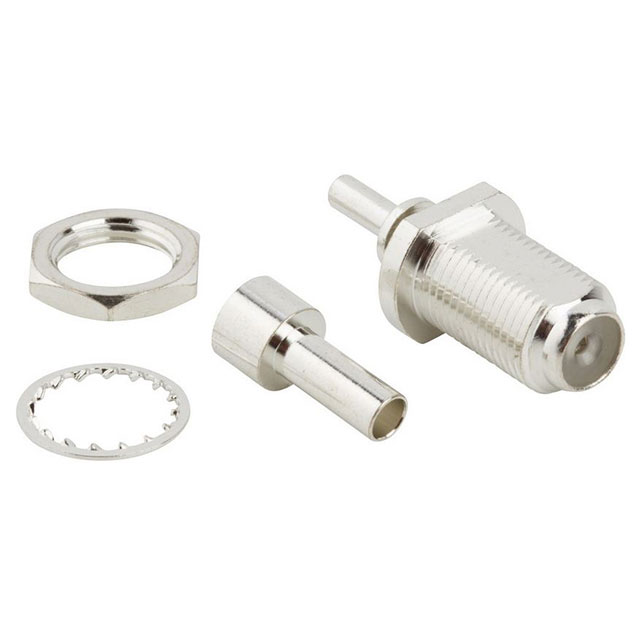
|
| Category | Coaxial Connectors (RF) | Coaxial Connectors (RF) |
| Manufacturer | Amphenol RF | Amphenol RF |
| Description | CONN BNC JACK R/A 50 OHM PCB | CONN F RCPT STR 75 OHM CRIMP |
| Package | - | - |
| Series | - | - |
| Mounting Type | Panel Mount, Through Hole, Right Angle | Panel Mount |
| Frequency - Max | 4GHz | 1GHz |
| Impedance | 50 Ohm | 75 Ohm |
| Mounting Feature | Bulkhead - Front Side Nut | Bulkhead - Front Side Nut |
| Connector Type | Jack, Female Socket | Receptacle, Female Socket |
| Contact Termination | Solder | Crimp |
| Connector Style | BNC | F Type |
| Fastening Type | Bayonet Lock | Threaded |
| Housing Color | Silver | Silver |
| Shield Termination | Solder | Crimp |
| Number of Ports | 1 | 1 |
| Cable Group | - | RG-179, 179A, 179B, 187, 187A, Belden 9221, M17/94-RG179 |
-
1. What is a coaxial connector?
Device for connecting coaxial cables
A coaxial connector is a device used to connect coaxial cables or other electronic devices, primarily used in radio frequency (RF) and microwave communications systems. It effectively reduces signal loss and provides good shielding to prevent electromagnetic interference (EMI).
Basic structure and working principle
The basic structure of a coaxial connector includes an inner conductor, an insulator, an outer conductor and a shield. The inner conductor is usually needle-shaped or hole-shaped, the insulator isolates the inner and outer conductors, and the outer conductor and shielding layer provide electromagnetic shielding to prevent signal interference. -
2. What is coaxial cable in electrical?
Coaxial cable is a transmission medium consisting of an inner conductor, an insulation layer, an outer conductor and a sheath. The inner conductor is usually one or more copper wires, and the outer conductor is composed of a metal braid or metal foil, both located on the same axis. This structure enables coaxial cables to have lower losses and higher anti-interference capabilities when transmitting high-frequency signals.
Coaxial cable structure and characteristics
The structure of coaxial cable includes the following parts:
Inner conductor: usually consists of a single or multiple copper wires.
Insulating layer: Located outside the inner conductor, it acts as an isolation and dielectric.
Outer conductor: usually constructed of metal braid or metal foil to form a shield.
Jacket: The outer layer that protects a cable, usually made of PVC or Teflon material. -
3. What is also called an RF connector?
RF coaxial connector
RF connector, also called radio frequency coaxial connector, is a type of radio frequency connector. RF connectors are mainly used for the transmission and connection of radio frequency signals and are widely used in wireless communications, radio, television, radar and other fields.
historical background
The earliest RF connector-UHF connector was born in 1930. During World War II, due to war needs, the development of radio, radar and microwave communications promoted the innovation of RF connectors, and series connectors such as BNC, TNC, and N appeared34. After 1958, SMA, SMB, SMC, etc. were miniaturized Products came out one after another. In 1964, the United States formulated the "General Specification for Radio Frequency Coaxial Connectors", which promoted the standardization, serialization and generalization of RF connectors. -
4. What is a coaxial F-type connector?
Coaxial RF connector, F-type connector
The coaxial F-type connector is a radio frequency coaxial connector, which is widely used in the fields of cable TV, satellite TV, cable TV modem and TV connection. It is characterized by threaded connection, convenient insertion, and stable performance. It is suitable for occasions with impedance matching requirements and non-matching occasions.
Definition and historical background
The F-type connector was first invented by Eric Winston in the early 1950s and became a common connection connector for VHF television antennas in the United States in the 1970s. Its characteristic impedance is 75 ohms, and the highest frequency can generally support 1GHz or 2.4GHz.
