
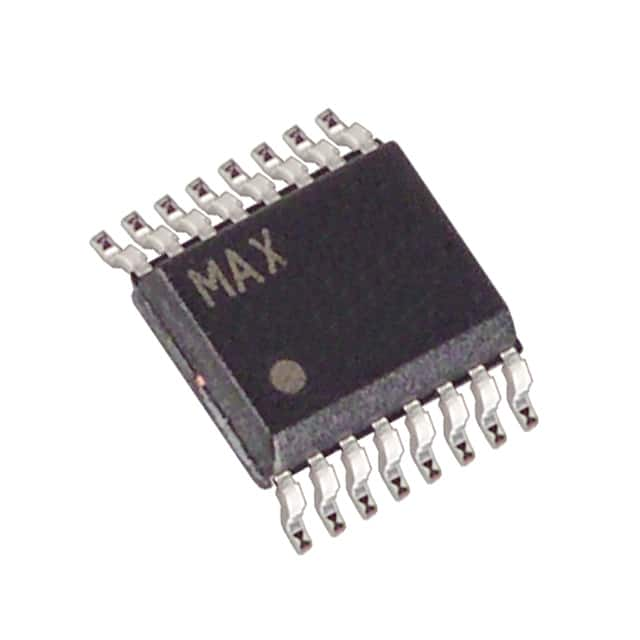
ADC104S101CIMM/NOPB vs MAX11605EEE+T
| Part Number |

|
|
| Category | Data Acquisition - Analog to Digital Converters (ADC) | Data Acquisition - Analog to Digital Converters (ADC) |
| Manufacturer | National Semiconductor | Maxim Integrated |
| Description | IC ADC 10BIT SAR 10VSSOP | IC ADC 8BIT SAR 16QSOP |
| Package | Bulk | Cut Tape (CT) |
| Series | - | - |
| Features | - | - |
| Operating Temperature | -40°C ~ 85°C | -40°C ~ 85°C |
| Mounting Type | Surface Mount | Surface Mount |
| Package / Case | 10-TFSOP, 10-MSOP (0.118\", 3.00mm Width) | 16-SSOP (0.154\", 3.90mm Width) |
| Supplier Device Package | 10-VSSOP | 16-QSOP |
| Reference Type | Supply | External, Internal |
| Sampling Rate (Per Second) | 1M | 188k |
| Data Interface | SPI, DSP | I²C |
| Number of Bits | 10 | 8 |
| Voltage - Supply, Analog | 2.7V ~ 5.25V | 2.7V ~ 3.6V |
| Voltage - Supply, Digital | 2.7V ~ 5.25V | 2.7V ~ 3.6V |
| Number of Inputs | 4 | 6, 12 |
| Input Type | Single Ended | Pseudo-Differential, Single Ended |
| Configuration | MUX-S/H-ADC | MUX-S/H-ADC |
| Ratio - S/H:ADC | 1:1 | 1:1 |
| Number of A/D Converters | 1 | 1 |
| Architecture | SAR | SAR |
-
1. How does ADC convert analog to digital?
The technology that converts analog sound signals into digital signals is called analog-to-digital conversion technology (Analog to Digital Converter, referred to as ADC). The function of ADC is to convert continuously changing analog signals into discrete digital signals. The process of analog-to-digital conversion can be completed by steps such as sampling, holding, quantization, and encoding.
-
2. What are DAC and ADC?
ADC and DAC are two important concepts in digital electronics. ADC stands for "analog-to-digital converter", which can convert analog signals into digital signals. DAC stands for "digital-to-analog converter", which can convert digital signals into analog signals. Both converters play an important role in many electronic products, such as mobile phones, televisions, stereos, etc.
-
3. What process converts analog to digital?
There are three basic processes for analog to digital conversion:
The first process is "sampling", which is to extract the sample value of the analog signal at equal intervals to turn the continuous signal into a discrete signal.
The second process is called "quantization", which is to convert the extracted sample value into the closest digital value to represent the size of the extracted sample value.
The third process is "encoding", which is to represent the quantized value with a set of binary digits. After these three processes, the digitization of the analog signal can be completed. This method is called "pulse encoding".
After the digital signal is transmitted to the receiving end, a restoration process is required, that is, the received digital signal is converted back to an analog signal so that it can be understood by the receiver. This process is called "digital-to-analog conversion", which reproduces it as sound or image. -
4. What is the difference between the input and output of an ADC?
The input of ADC (Analog-to-Digital Converter) is analog quantity and the output is digital quantity.
The main function of ADC is to convert continuous analog signal into discrete digital signal. In electronic systems, analog signal usually refers to continuously changing voltage or current, such as the signal obtained from microphone or sensor. The amplitude and frequency of these analog signals can change continuously, while digital signals are composed of a series of discrete values, usually expressed in binary form.
Input: The input of ADC receives analog signals, which can be in the form of continuously changing physical quantities such as voltage and current. The amplitude and frequency of analog signals can change continuously, such as the voltage range from 0V to 5V.
Output: The output of ADC is digital signal, which is composed of a series of discrete values, usually expressed in binary form. The advantage of digital signals is that they can be calculated and processed quic
