
BFC237965114 vs T523J227M016APE0707280
| Part Number |
|
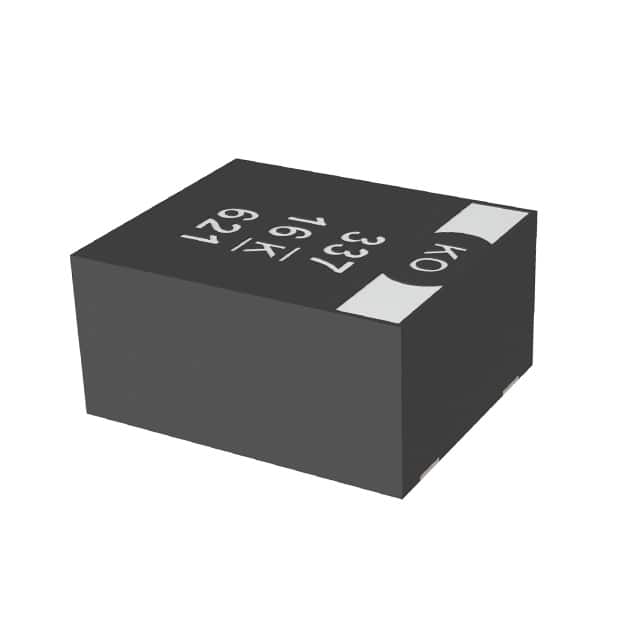
|
| Category | Film Capacitors | Film Capacitors |
| Manufacturer | Vishay Beyschlag/Draloric/BC Components | KEMET |
| Description | CAP FILM 0.11UF 5% 630VDC RADIAL | CAP TANT POLY 220UF 16V 2924 |
| Package | Tape & Reel (TR) | Tape & Reel (TR) |
| Series | MKP379 | KO-CAP® T523 |
| Features | Long Life | General Purpose |
| Operating Temperature | -55°C ~ 85°C | -55°C ~ 85°C |
| Mounting Type | Through Hole | Surface Mount |
| Package / Case | Radial | 2924 (7360 Metric) |
| Applications | High Pulse, DV/DT | - |
| Tolerance | ±5% | ±20% |
| Size / Dimension | 0.689" L x 0.276" W (17.50mm x 7.00mm) | 0.287" L x 0.236" W (7.30mm x 6.00mm) |
| Termination | PC Pins | - |
| Voltage Rating - AC | 220V | - |
| Voltage Rating - DC | 630V | - |
| Lead Spacing | 0.591\" (15.00mm) | - |
| Ratings | - | - |
| Height - Seated (Max) | 0.532\" (13.50mm) | 0.059\" (1.50mm) |
| Capacitance | 0.11 µF | 220 µF |
| ESR (Equivalent Series Resistance) | - | 70mOhm @ 100kHz |
| Dielectric Material | Polypropylene (PP), Metallized | - |
| Type | - | Molded |
| Voltage - Rated | - | 16 V |
| Lifetime @ Temp. | - | 2000 Hrs @ 85°C |
| Manufacturer Size Code | - | J |
-
1. Is a film capacitor AC or DC?
AC, DC
Film capacitors can be used in both AC and DC circuits. According to the current type, film capacitors can be divided into DC film capacitors and AC film capacitors.
DC film capacitors
DC film capacitors are mainly used in DC circuits and have the following characteristics:
Large capacity: has a higher capacitance.
Low withstand voltage: the withstand voltage value is relatively low.
Polarity: has positive and negative poles.
Application scenarios: commonly used in motor drives, uninterruptible power supplies (UPS), solar inverters, electronic ballasts, small automotive motors, household appliances, etc.
AC film capacitors
AC film capacitors are mainly used in AC circuits and have the following characteristics:
Small capacity: relatively small capacitance.
High withstand voltage: high withstand voltage value.
Pass AC, block DC: conduct electricity in AC circuits, equivalent to open circuits in DC circuits.
Application scenarios: widely used in industrial AC power supplies, asynchronous motor starting and operation, uninterruptible power supplies (UPS) and output filters of photovoltaic inverters, etc. -
2. What is a paper film capacitor?
Paper film capacitors are actually a conceptual error because "paper film capacitors" are not a standard type of capacitor. Based on the information provided, you may want to ask about paper capacitors and film capacitors.
Paper capacitors
Paper capacitors are capacitors that use paper as a dielectric. It consists of thin paper as the dielectric and aluminum foil as the electrode, which is wound into a cylindrical shape and then impregnated with a shell or epoxy resin. Paper capacitors have the following characteristics:
Low cost: Paper capacitors are usually low-cost and suitable for mass production.
Large loss: Due to its material properties, paper capacitors have large losses.
Application scenarios: Mainly used for bypass, coupling, filtering, etc. in low-frequency circuits. -
3. Can film capacitors be used for AC?
Yes
Film capacitors can be used for AC. Film capacitors can work normally in AC circuits and have specific application scenarios and advantages.
Structure and working principle of film capacitors
Film capacitors are mainly composed of metal foil (or foil obtained by metallizing plastic) as electrode plates and plastic film as dielectric. Common plastic films include polyethylene, polypropylene, polystyrene or polycarbonate. These capacitors are usually made by winding or stacking processes to form a cylindrical structure. -
4. What is the difference between foil capacitors and film capacitors?
Electrode materials, structure, and application areas
The main difference between foil capacitors and film capacitors lies in electrode materials, structures, and application areas.
Electrode materials and structures
Foil capacitors: Foil capacitors usually use metal foil as electrodes. This electrode is formed on a plastic film by vacuum evaporation, which is called a metallized film. This structure can save the thickness of the electrode foil, thereby reducing the volume of the capacitor and making it more miniaturized.
Film capacitors: Film capacitors use plastic films as dielectrics. Common plastic films include polyethylene, polypropylene, polystyrene or polycarbonate. These films overlap at both ends and are rolled into a cylinder to form a capacitor.
