
BFC238311394 vs T523J227M016APE0707280
| Part Number |
|
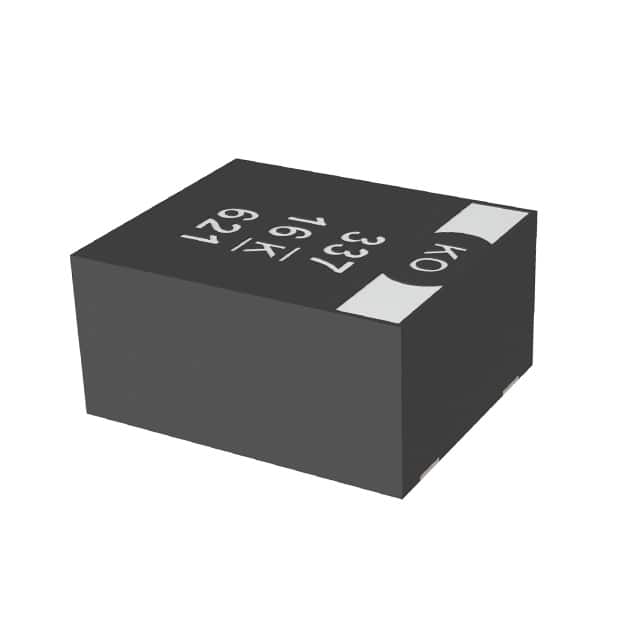
|
| Category | Film Capacitors | Film Capacitors |
| Manufacturer | Vishay Beyschlag/Draloric/BC Components | KEMET |
| Description | CAP FILM 0.39UF 5% 400VDC RADIAL | CAP TANT POLY 220UF 16V 2924 |
| Package | Bulk | Tape & Reel (TR) |
| Series | MMKP383 | KO-CAP® T523 |
| Features | - | General Purpose |
| Operating Temperature | -55°C ~ 105°C | -55°C ~ 85°C |
| Mounting Type | Through Hole | Surface Mount |
| Package / Case | Radial | 2924 (7360 Metric) |
| Applications | High Pulse, DV/DT | - |
| Tolerance | ±5% | ±20% |
| Size / Dimension | 1.024" L x 0.394" W (26.00mm x 10.00mm) | 0.287" L x 0.236" W (7.30mm x 6.00mm) |
| Termination | PC Pins | - |
| Voltage Rating - AC | 200V | - |
| Voltage Rating - DC | 400V | - |
| Lead Spacing | 0.886\" (22.50mm) | - |
| Ratings | - | - |
| Height - Seated (Max) | 0.768\" (19.50mm) | 0.059\" (1.50mm) |
| Capacitance | 0.39 µF | 220 µF |
| ESR (Equivalent Series Resistance) | - | 70mOhm @ 100kHz |
| Dielectric Material | Polypropylene (PP), Metallized | - |
| Type | - | Molded |
| Voltage - Rated | - | 16 V |
| Lifetime @ Temp. | - | 2000 Hrs @ 85°C |
| Manufacturer Size Code | - | J |
-
1. What is a paper film capacitor?
Paper film capacitors are actually a conceptual error because "paper film capacitors" are not a standard type of capacitor. Based on the information provided, you may want to ask about paper capacitors and film capacitors.
Paper capacitors
Paper capacitors are capacitors that use paper as a dielectric. It consists of thin paper as the dielectric and aluminum foil as the electrode, which is wound into a cylindrical shape and then impregnated with a shell or epoxy resin. Paper capacitors have the following characteristics:
Low cost: Paper capacitors are usually low-cost and suitable for mass production.
Large loss: Due to its material properties, paper capacitors have large losses.
Application scenarios: Mainly used for bypass, coupling, filtering, etc. in low-frequency circuits. -
2. Are film capacitors suitable for audio?
Suitable
Film capacitors are very suitable for audio applications. Film capacitors perform well in audio circuits and have the following advantages:
Non-polarity: Film capacitors have no positive or negative poles, which gives them greater flexibility in circuit design.
High insulation impedance: The insulation impedance of film capacitors is very high, which can effectively reduce leakage current in the circuit and improve the stability of the circuit.
Excellent frequency characteristics: Film capacitors have a wide frequency response and can provide stable capacitance performance in the high and low frequency ranges, which is suitable for various frequency changes in audio circuits.
Low dielectric loss: The dielectric loss of film capacitors is very small, which means that during the transmission of audio signals, less energy is lost and the integrity of the signal is maintained.
Self-healing properties: Film capacitors have self-healing properties and can automatically repair internal defects when they occur, extending their service life. -
3. Will the performance of film capacitors degrade?
Yes
The performance of film capacitors will degrade. The performance degradation of film capacitors is mainly due to their internal structure and material properties.
Reasons for performance degradation
Metal plating oxidation: During the capacitor manufacturing process, there is a trace amount of air between the film layers, which may be ionized under the action of the electric field to produce ozone. Ozone is a strong oxidant that oxidizes the metal plating to produce non-conductive metal oxides, resulting in a reduction in the plate area and a decrease in the capacitor capacity.
Humid air: During the winding process of film capacitors, if the workshop environment is not properly controlled, there will be a large amount of humid air. These humid air will produce air ionization reactions when the capacitor is working, generating ozone, which further causes the capacitor capacity to decay.
Poor quality materials: The film materials used are of poor quality, such as uneven evaporation and defects on the film, which will cause the capacitor capacity to decay.
-
4. How do film capacitors fail?
High working environment temperature, improper selection of working current, exceeding the specified working voltage, harmonic current
The main reasons for film capacitor failure include the following:
High working environment temperature: Film capacitors can work normally in a temperature environment of -40℃~+105℃, but exceeding this range will accelerate thermal aging, resulting in a shortened service life, and even bursting in severe cases.
Improper selection of working current: The current value in the circuit should be less than the current value allowed by the film capacitor, otherwise it will cause the capacitor to heat up, and long-term use will shorten the life, and even burst in severe cases.
Exceeding the specified working voltage: Excessive voltage will cause partial discharge, which will then break down the capacitor and cannot be used.
There are harmonic currents: high-order harmonic currents are superimposed on fundamental currents, resulting in an increase in total current, causing capacitor load overload, internal expansion, and explosion.
Buying inferior capacitors: In order to reduce costs, some manufacturers on the market use low-quality materials to produce capacitors, which greatly reduces the actual withstand voltage and life of such capacitors.
The structural characteristics of film capacitors and the impact of the use environment on their performance:
Film capacitors are usually composed of polypropylene film, aluminum foil and plastic shell. Polypropylene film is sensitive to high temperature, which accelerates its aging and shortens the life of the capacitor. In addition, a humid environment will also cause water vapor to enter the capacitor, affecting its performance.
