
CWR26HB106KBFB\HR vs M39003/01-2791
| Part Number |
|

|
| Category | Tantalum Capacitors | Tantalum Capacitors |
| Manufacturer | Vishay Sprague | Vishay Sprague |
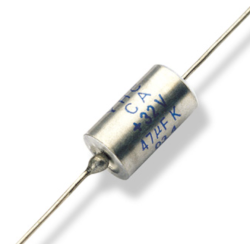
| Description | CAP TANT 10UF 10% 15V 2214 | CAP TANT 39UF 10% 35V AXIAL |
| Package | Tape & Reel (TR) | Bulk |
| Series | Military, MIL-PRF-55365/13, CWR26 | Military, MIL-PRF-39003/1, CSR13 |
| Type | Conformal Coated | Hermetically Sealed |
| Features | High Reliability | High Reliability |
| Operating Temperature | -55°C ~ 125°C | -55°C ~ 125°C |
| Mounting Type | Surface Mount | Through Hole |
| Package / Case | 2214 (5634 Metric) | Axial |
| Tolerance | ±10% | ±10% |
| Size / Dimension | 0.220" L x 0.135" W (5.59mm x 3.43mm) | 0.351" Dia x 0.786" L (8.92mm x 19.96mm) |
| Voltage - Rated | 15 V | 35 V |
| Lead Spacing | - | - |
| Ratings | - | - |
| Height - Seated (Max) | 0.085\" (2.16mm) | - |
| Capacitance | 10 µF | 39 µF |
| ESR (Equivalent Series Resistance) | 667mOhm | - |
| Lifetime @ Temp. | - | - |
| Failure Rate | B (0.1%) | R (0.01%) |
| Manufacturer Size Code | F | D |
-
1. Disadvantages of tantalum capacitors
The price is relatively high.
If used improperly or the circuit design is defective, it may fail, including explosion.
It is polarity sensitive and can only work in the specified direction.
It may fail easily under certain conditions (such as overvoltage, surge current). -
2. Why do tantalum capacitors explode?
The main reason is that excessive voltage or current shocks cause internal short circuits, which trigger thermal runaway.
Excessive ambient temperature may also exacerbate this situation. -
3. When to use tantalum capacitors?
When miniaturization, low ESR (equivalent series resistance), and stable operation over a wide temperature range are required.
Suitable for audio processing, communication equipment, computer motherboards and other fields. -
4. What special precautions must be taken when installing tantalum capacitors?
Ensure the correct polarity connection.
Be careful not to exceed the rated voltage.
Use appropriate fuses or other protective devices to prevent overcurrent.
Consider heat dissipation design to avoid local overheating.
