
CWR26KH106MBGZ\HR vs CWR26HK226MBGZ\HR
| Part Number |
|

|
| Category | Tantalum Capacitors | Tantalum Capacitors |
| Manufacturer | Vishay Sprague | Vishay Sprague |
| Description | CAP TANT 10UF 20% 25V 2711 | CAP TANT 22UF 20% 15V 2711 |
| Package | Tape & Reel (TR) | Tape & Reel (TR) |
| Series | Military, MIL-PRF-55365/13, CWR26 | Military, MIL-PRF-55365/13, CWR26 |
| Type | Conformal Coated | Conformal Coated |
| Features | High Reliability | High Reliability |
| Operating Temperature | -55°C ~ 125°C | -55°C ~ 125°C |
| Mounting Type | Surface Mount | Surface Mount |
| Package / Case | 2711 (6728 Metric) | 2711 (6728 Metric) |
| Tolerance | ±20% | ±20% |
| Size / Dimension | 0.265" L x 0.110" W (6.73mm x 2.79mm) | 0.265" L x 0.110" W (6.73mm x 2.79mm) |
| Voltage - Rated | 25 V | 15 V |
| Lead Spacing | - | - |
| Ratings | - | - |
| Height - Seated (Max) | 0.125\" (3.17mm) | 0.125\" (3.17mm) |
| Capacitance | 10 µF | 22 µF |
| ESR (Equivalent Series Resistance) | 350mOhm | 275mOhm |
| Lifetime @ Temp. | - | - |
| Failure Rate | B (0.1%) | B (0.1%) |
| Manufacturer Size Code | G | G |
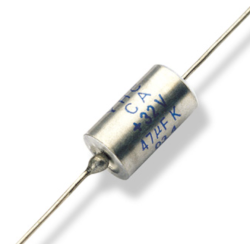
-
1. Why are tantalum capacitors so expensive?
Tantalum ore resources are scarce and the mining cost is high.
The manufacturing process is complex and the yield is relatively low.
It has excellent electrical characteristics, making it indispensable in high-end applications. -
2. Why do tantalum capacitors explode?
The main reason is that excessive voltage or current shocks cause internal short circuits, which trigger thermal runaway.
Excessive ambient temperature may also exacerbate this situation. -
3. Is tantalum better than tungsten?
It depends on the application. For capacitors, tantalum is preferred due to its unique properties; while in some other industrial uses, such as making filaments, tungsten is preferred.
-
4. What special precautions must be taken when installing tantalum capacitors?
Ensure the correct polarity connection.
Be careful not to exceed the rated voltage.
Use appropriate fuses or other protective devices to prevent overcurrent.
Consider heat dissipation design to avoid local overheating.
