
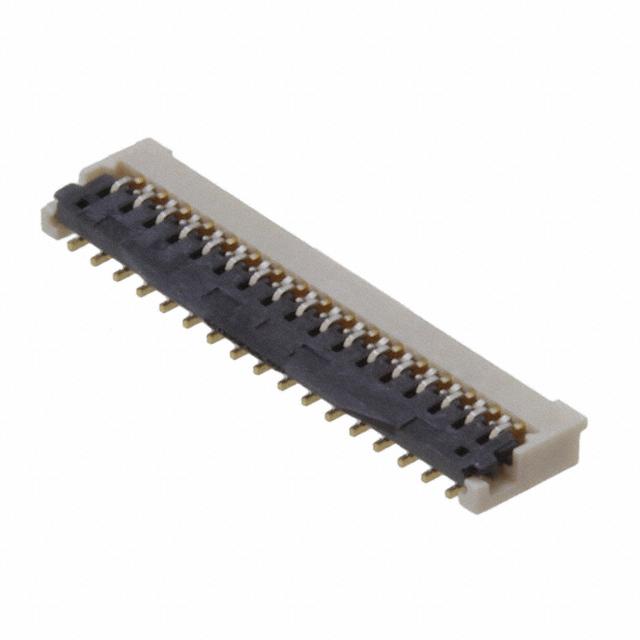
FH19C-8S-0.5SH(10) vs FB10S033JA2R6000
| Part Number |

|
|
| Category | FFC, FPC (Flat Flexible) Connectors | FFC, FPC (Flat Flexible) Connectors |
| Manufacturer | Hirose Electric Co Ltd | JAE Electronics |
| Description | CONN FFC BOTTOM 8POS 0.50MM R/A | CONN FPC BOTTOM 33POS 0.30MM R/A |
| Package | - | - |
| Series | FH19C | FB10 |
| Features | Solder Retention, Zero Insertion Force (ZIF) | Zero Insertion Force (ZIF) |
| Operating Temperature | -55°C ~ 85°C | -40°C ~ 85°C |
| Mounting Type | Surface Mount, Right Angle | Surface Mount, Right Angle |
| Termination | Solder | Solder |
| Contact Material | Phosphor Bronze | Phosphor Bronze |
| Contact Finish | Gold | Gold |
| Flat Flex Type | FFC, FPC | FPC |
| Connector/Contact Type | Contacts, Bottom | Contacts, Bottom |
| Number of Positions | 8 | 33 |
| Pitch | 0.020" (0.50mm) | 0.012" (0.30mm) |
| FFC, FCB Thickness | 0.20mm | 0.20mm |
| Height Above Board | 0.036" (0.90mm) | 0.036" (0.90mm) |
| Locking Feature | Flip Lock | Flip Lock |
| Cable End Type | Tapered | Tabbed or Tapered |
| Housing Material | Liquid Crystal Polymer (LCP) | Plastic |
| Voltage Rating | 50V | 50V |
| Material Flammability Rating | UL94 V-0 | - |
| Actuator Material | Liquid Crystal Polymer (LCP), Polyphenylene Sulfide (PPS) | Plastic |
-
1. What is the difference between FFC and FPC connectors?
The main differences between FFC connectors and FPC connectors are in design, application, and performance.
Design Differences
FPC connectors: usually have a multi-layer structure and complex circuit design, are made of conductive materials, and are connected to circuit boards by welding, crimping, etc. FPC connectors are suitable for circuit boards of various shapes and sizes, have extremely high flexibility, and can adapt to different bending and twisting requirements.
FFC connectors: The structure is relatively simple, mainly composed of insulating materials and conductive materials, and are connected to cables by crimping or plugging. FFC connectors are usually used to connect components such as display screens, touch screens, and keyboards. Their flat design makes the cable more stable and reliable during the connection process. -
2. What is an FPC connector?
FPC connector (Flexible Printed Circuit Connector) is an electronic component designed for connecting flexible printed circuit boards (FPC). It has the characteristics of compact structure, light weight, and strong flexibility, and is widely used in electronic products with high space and weight requirements such as mobile phones, laptops, tablets, wearable devices, and camera modules.
The main features of FPC connectors include:
Miniaturization and high-density integration: can save space and simplify wiring procedures, thereby reducing labor costs.
Excellent flexibility: allows flexible twists and turns to adapt to various complex connection requirements.
Lightweight and low-cost: small size, light weight, easy installation, and strong durability. -
3. What is the difference between flexible PCB and FPC?
There are some differences between flexible PCB (FPC) and flexible circuit board (FPC) in definition and application scenarios.
Definition and materials
Flexible PCB (FPC): Flexible PCB is a type of flexible circuit board, usually made of flexible substrates such as polyimide (PI) or polyester film (PET). This material makes FPC have good flexibility and bendability, can move and stretch freely in three-dimensional space, and is suitable for electronic products that require high density, miniaturization and high reliability.
Flexible circuit board (FPC): Flexible circuit board is a printed circuit board made of polyimide or polyester film as the substrate, with high reliability and excellent flexibility. It has the characteristics of high wiring density, light weight, thin thickness, good bending, and can withstand millions of dynamic bending without damaging the wires.
-
4. What is the use of FFC cable?
FFC cable (Flexible Flat Cable) is mainly used to connect mobile parts with motherboards, PCB boards with PCB boards, and data transmission in miniaturized electrical equipment.
FFC cable has the following main features:
High flexibility: The number and spacing of wires can be arbitrarily selected, making wiring more convenient, greatly reducing the volume of electronic products, reducing production costs, and improving production efficiency.
Environmental resistance: It has anti-bending and anti-tensile functions, good flexibility, cold and high temperature resistance.
Wide application: It is suitable for use as a data transmission cable between mobile parts and motherboards, between PCB boards and PCB boards, and in miniaturized electrical equipment.
