
MKP385424085JKM2T0 vs BFC241814704
| Part Number |
|
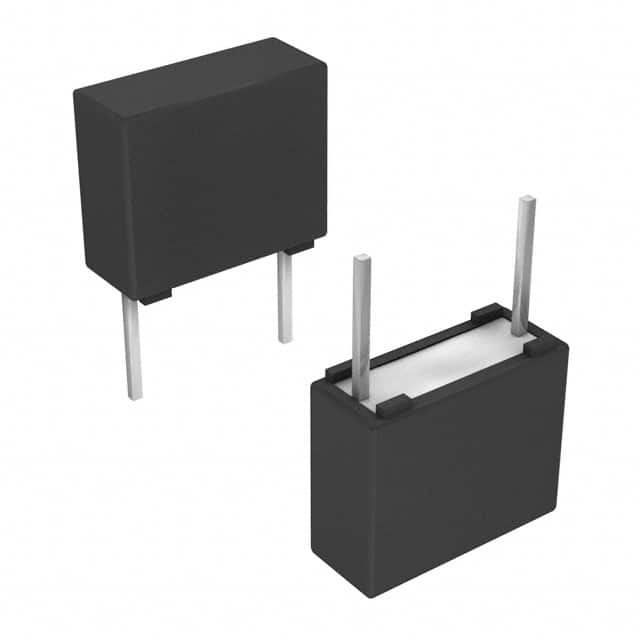
|
| Category | Film Capacitors | Film Capacitors |
| Manufacturer | Vishay Beyschlag/Draloric/BC Components | Vishay Beyschlag/Draloric/BC Components |
| Description | CAP FILM 0.24UF 5% 850VDC RADIAL | CAP FILM 0.47UF 2% 250VDC RADIAL |
| Package | Tray | Tape & Reel (TR) |
| Series | MKP385 | MKP418 |
| Features | - | - |
| Operating Temperature | -55°C ~ 110°C | -55°C ~ 85°C |
| Mounting Type | Through Hole | Through Hole |
| Package / Case | Radial | Radial |
| Applications | DC Link, DC Filtering; High Frequency, Switching; High Pulse, DV/DT | High Frequency, Switching |
| Tolerance | ±5% | ±2% |
| Size / Dimension | 1.240" L x 0.354" W (31.50mm x 9.00mm) | 0.689" L x 0.335" W (17.50mm x 8.50mm) |
| Termination | PC Pins | PC Pins |
| Voltage Rating - AC | 300V | 25V |
| Voltage Rating - DC | 850V | 250V |
| Lead Spacing | 1.083\" (27.50mm) | 0.591\" (15.00mm) |
| Ratings | - | - |
| Height - Seated (Max) | 0.748\" (19.00mm) | 0.591\" (15.00mm) |
| Capacitance | 0.24 µF | 0.47 µF |
| ESR (Equivalent Series Resistance) | - | - |
| Dielectric Material | Polypropylene (PP), Metallized | Polypropylene (PP), Metallized |
-
1. What are the uses of film capacitors?
High-frequency filtering, power decoupling, power noise bypass
The main uses of film capacitors include high-frequency filtering, power decoupling, power noise bypass, etc. In electronic devices, film capacitors are widely used in various circuits due to their high insulation impedance, wide frequency response and self-healing properties.
Specific application scenarios
High-frequency filtering: Film capacitors have excellent high-frequency insulation performance, and the capacitance and loss angle are independent of frequency in a large frequency range and change little with temperature, so they are often used in high-frequency filtering circuits.
Power decoupling: In car audio systems, film capacitors are used for power decoupling to ensure stable power supply and avoid noise caused by feedback generated by the power supply.
Power noise bypass: Film capacitors are also widely used for power noise bypass (reverse cross-connection) to reduce the impact of power noise on the circuit.
Different types of applications
CBB film capacitors: widely used in circuit boards because of their high insulation impedance and wide frequency response.
Organic film capacitors: Made of materials such as polypropylene film and polyester film, they have excellent performance, a wide variety of varieties, and a wide range of applications. They are suitable for a variety of electronic devices.
-
2. What is a paper film capacitor?
Paper film capacitors are actually a conceptual error because "paper film capacitors" are not a standard type of capacitor. Based on the information provided, you may want to ask about paper capacitors and film capacitors.
Paper capacitors
Paper capacitors are capacitors that use paper as a dielectric. It consists of thin paper as the dielectric and aluminum foil as the electrode, which is wound into a cylindrical shape and then impregnated with a shell or epoxy resin. Paper capacitors have the following characteristics:
Low cost: Paper capacitors are usually low-cost and suitable for mass production.
Large loss: Due to its material properties, paper capacitors have large losses.
Application scenarios: Mainly used for bypass, coupling, filtering, etc. in low-frequency circuits. -
3. Are film capacitors suitable for audio?
Suitable
Film capacitors are very suitable for audio applications. Film capacitors perform well in audio circuits and have the following advantages:
Non-polarity: Film capacitors have no positive or negative poles, which gives them greater flexibility in circuit design.
High insulation impedance: The insulation impedance of film capacitors is very high, which can effectively reduce leakage current in the circuit and improve the stability of the circuit.
Excellent frequency characteristics: Film capacitors have a wide frequency response and can provide stable capacitance performance in the high and low frequency ranges, which is suitable for various frequency changes in audio circuits.
Low dielectric loss: The dielectric loss of film capacitors is very small, which means that during the transmission of audio signals, less energy is lost and the integrity of the signal is maintained.
Self-healing properties: Film capacitors have self-healing properties and can automatically repair internal defects when they occur, extending their service life. -
4. What is the difference between foil capacitors and film capacitors?
Electrode materials, structure, and application areas
The main difference between foil capacitors and film capacitors lies in electrode materials, structures, and application areas.
Electrode materials and structures
Foil capacitors: Foil capacitors usually use metal foil as electrodes. This electrode is formed on a plastic film by vacuum evaporation, which is called a metallized film. This structure can save the thickness of the electrode foil, thereby reducing the volume of the capacitor and making it more miniaturized.
Film capacitors: Film capacitors use plastic films as dielectrics. Common plastic films include polyethylene, polypropylene, polystyrene or polycarbonate. These films overlap at both ends and are rolled into a cylinder to form a capacitor.
