
RCME0510001BYS14 vs RLP02NR3640DS14
| Part Number |
|

|
| Category | Through Hole Resistors | Through Hole Resistors |
| Manufacturer | Vishay Sfernice | Vishay Sfernice |
| Description | SFERNICE FIXED RESISTORS | SFERNICE FIXED RESISTORS |
| Package | Bag | Bag |
| Series | - | - |
| Features | - | - |
| Operating Temperature | - | - |
| Package / Case | - | - |
| Supplier Device Package | - | - |
| Tolerance | - | - |
| Temperature Coefficient | - | - |
| Size / Dimension | - | - |
| Power (Watts) | - | - |
| Height - Seated (Max) | - | - |
| Failure Rate | - | - |
| Resistance | - | - |
| Composition | - | - |
| Number of Terminations | - | - |

-
1. What are the packaging methods of through-hole resistors?
The DIP package is a double-row in-line package with two rows of pins arranged in parallel. DIP packages are widely used in integrated circuits, resistors, capacitors and other components, such as operational amplifiers, microcontrollers, etc.
The SIP package is a single-row in-line package with one row of pins. SIP packages are commonly used in resistor arrays, capacitor arrays and power modules. -
2. Through-hole resistor calculation method
The calculation method of through-hole resistor mainly depends on the basic calculation formula of resistor, that is, R=P*L/s, where R represents the resistance value, ρ is the resistivity, L is the length of the resistor, and S is the cross-sectional area of the resistor.
Through-hole resistors usually have a metal film or carbon film on the outside and a through hole in the middle. This structure allows for easy installation by inserting a metal rod. Through-hole resistors can be divided into precision and ordinary types. Precision plug-in resistors refer to resistors whose parameters meet certain requirements, such as a precision of 0.1%, a package of 1550, and a TCR (temperature coefficient) of 10PPM/℃. -
3. Resistor parameters
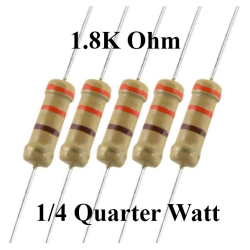
Through-hole resistor 10k/0.25w parameters
The parameters of the through-hole resistor 10k/0.25w include nominal resistance 10KΩ, rated power 0.25W, accuracy 1%, and installation type is through-hole.
Nominal resistance: 10KΩ, indicating that the basic resistance of the resistor is 10,000 ohms.
Rated power: 0.25W, meaning that the maximum power the resistor can withstand continuously is 0.25 watts.
Accuracy: 1%, indicating that the deviation between the actual resistance of the resistor and the nominal resistance does not exceed 1%.
Mounting type: through-hole, indicating that this resistor is suitable for through-hole installation, usually for through-hole installation on circuit boards. -
4. What are the advantages of through-hole resistors?
Strong component connection: Through-hole technology passes through the circuit board through physical leads and is soldered on the other side, forming a strong connection that can resist mechanical stress. This makes through-hole resistors an excellent choice for components that are subject to physical strain, such as connectors, switches, or large, heavy components.
Reliable performance at high temperatures: Through-hole components are generally more resistant to extreme thermal environments, which is beneficial for applications that operate in high-temperature environments or undergo significant thermal cycles.
Easy to prototype and debug: Through-hole components are generally easier to use for manual assembly, prototyping, or testing. They can be manually inserted and soldered, making it easy to debug or modify prototypes.
Enhanced testability: Circuit boards designed with through-hole designs inherently provide excellent testability. The lead ends of the devices in the through-hole board also act as test nodes, which enables efficient online testing because the test probes can easily access them from the bottom. This makes it easier and more efficient to diagnose and fix any potential problems.
