
RN55C1450BB14 vs RN55C1470FB14
| Part Number |

|

|
| Category | Through Hole Resistors | Through Hole Resistors |
| Manufacturer | Vishay Dale | Vishay Dale |
| Description | RES 145 OHM 1/8W .1% AXIAL | RES 147 OHM 1/8W 1% AXIAL |
| Package | Bulk | Bulk |
| Series | Military, MIL-R-10509/7, RN55 | Military, MIL-R-10509/7, RN55 |
| Features | Flame Retardant Coating, Military, Moisture Resistant, Safety | Flame Retardant Coating, Military, Moisture Resistant, Safety |
| Operating Temperature | -65°C ~ 175°C | -65°C ~ 175°C |
| Package / Case | Axial | Axial |
| Supplier Device Package | Axial | Axial |
| Tolerance | ±0.1% | ±1% |
| Temperature Coefficient | ±50ppm/°C | ±50ppm/°C |
| Size / Dimension | 0.090" Dia x 0.240" L (2.29mm x 6.10mm) | 0.090" Dia x 0.240" L (2.29mm x 6.10mm) |
| Power (Watts) | 0.125W, 1/8W | 0.125W, 1/8W |
| Height - Seated (Max) | - | - |
| Failure Rate | - | - |
| Resistance | 145 Ohms | 147 Ohms |
| Composition | Metal Film | Metal Film |
| Number of Terminations | 2 | 2 |

-
1. Through-hole resistor calculation method
The calculation method of through-hole resistor mainly depends on the basic calculation formula of resistor, that is, R=P*L/s, where R represents the resistance value, ρ is the resistivity, L is the length of the resistor, and S is the cross-sectional area of the resistor.
Through-hole resistors usually have a metal film or carbon film on the outside and a through hole in the middle. This structure allows for easy installation by inserting a metal rod. Through-hole resistors can be divided into precision and ordinary types. Precision plug-in resistors refer to resistors whose parameters meet certain requirements, such as a precision of 0.1%, a package of 1550, and a TCR (temperature coefficient) of 10PPM/℃. -
2. How to identify color ring resistors
1. Four-color ring resistors
Four-color ring resistors refer to resistors that use four color rings to indicate resistance, counting from left to right, as shown in the figure. The first color ring indicates the largest digit of the resistance; the second color ring indicates the second digit of the resistance; the third color ring indicates the number of times the resistance is multiplied; the fourth color ring indicates the allowable deviation (accuracy) of the resistance.
For example, if the first ring of a resistor is red (representing 2), the second ring is purple (representing 7), the third ring is brown (representing 10 times), and the fourth ring is gold (representing ±5%), then the resistance of this resistor should be 270Ω, and the error range of the resistance is ±5%.
2. Five-color ring resistor
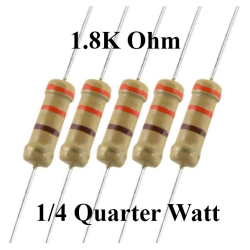
Five-color ring resistor refers to a resistor that uses five color rings to represent the resistance, counting from left to right, as shown in the figure. The first color ring represents the largest digit of the resistance; the second color ring represents the second digit of the resistance; the third color ring represents the third digit of the resistance; the fourth color ring represents the multiplier of the resistance; the fifth color ring represents the error range.
For example, if a five-color ring resistor, the first ring is red (representing 2), the second ring is red (representing 2), the third ring is black (representing 0), the fourth ring is black (representing 1 times), and the fifth ring is brown (representing ±1%), then its resistance is 220Ω×1=220Ω, and the error range is ±1%.
3. Six-color ring resistors
Six-color ring resistors refer to resistors that use six color rings to represent resistance values. As shown in Figure 1, the first five color rings of the six-color ring resistor are the same as the five-color ring resistor, and the sixth color ring represents the temperature coefficient of the resistor. -
3. Definition and function of through-hole resistors
A through-hole resistor is a resistor device that can fix the resistor body and wire by perforating holes to achieve the purpose of fixing and conducting current. Through-hole resistors are widely used in various circuits, such as power amplifiers, digital circuits, analog signal processors, etc.
-
4. What are the applications of through-hole resistors?
Voltage division: The required voltage is distributed through series resistors. It is often used for voltage sampling and current sampling. It is connected in series through precision resistors with small resistance. After voltage division, the voltage needs to be amplified by an amplifier.
Shunting: When the current in the loop is large and the power of one resistor is insufficient, the current is shunted through parallel resistors to play a protective role.
Current limiting: Limit the current passing through components to protect components, such as the current limiting resistor of LED light-emitting diodes.
Decoupling: In circuit operation, resistors are used to form a path to remove excess energy, which is used for inductive components.
Filtering: Together with capacitors, a filter circuit is formed. The cutoff frequency of the filter is calculated according to the resistance value and the capacitance value to achieve low-pass filtering or high-pass filtering.
Pull-up and pull-down: The pull-up resistor is connected to the positive end of the power supply, and the pull-down resistor is connected to the negative end of the power supply. It is used for signal output or input to prevent false operation caused by signal interference.
Dummy load: Connect a resistor in parallel with the output end of the power supply so that the output end does not form an empty load, which clamps the output voltage.
Jumper function: Mainly the use of 0 ohm resistors, used for debugging and compatibility, convenient wiring, reserved resistor positions, convenient current testing, noise suppression, safety protection and other occasions.
