
RNC50H1983BSRE6 vs RNC50H2263BRRE6
| Part Number |

|

|
| Category | Through Hole Resistors | Through Hole Resistors |
| Manufacturer | Vishay Dale | Vishay Dale |
| Description | RES 198K OHM 1/10W .1% AXIAL | RES 226K OHM 1/10W .1% AXIAL |
| Package | Tape & Reel (TR) | Tape & Reel (TR) |
| Series | Military, MIL-PRF-55182/07, RNC50 | Military, MIL-PRF-55182/07, RNC50 |
| Features | Military, Moisture Resistant, Weldable | Military, Moisture Resistant, Weldable |
| Operating Temperature | -65°C ~ 175°C | -65°C ~ 175°C |
| Package / Case | Axial | Axial |
| Supplier Device Package | Axial | Axial |
| Tolerance | ±0.1% | ±0.1% |
| Temperature Coefficient | ±50ppm/°C | ±50ppm/°C |
| Size / Dimension | 0.070" Dia x 0.150" L (1.78mm x 3.81mm) | 0.070" Dia x 0.150" L (1.78mm x 3.81mm) |
| Power (Watts) | 0.1W, 1/10W | 0.1W, 1/10W |
| Height - Seated (Max) | - | - |
| Failure Rate | S (0.001%) | R (0.01%) |
| Resistance | 198 kOhms | 226 kOhms |
| Composition | Metal Film | Metal Film |
| Number of Terminations | 2 | 2 |

-
1. What are the packaging methods of through-hole resistors?
The DIP package is a double-row in-line package with two rows of pins arranged in parallel. DIP packages are widely used in integrated circuits, resistors, capacitors and other components, such as operational amplifiers, microcontrollers, etc.
The SIP package is a single-row in-line package with one row of pins. SIP packages are commonly used in resistor arrays, capacitor arrays and power modules. -
2. Resistor parameter marking
1. Direct marking method: directly mark the resistance value and allowable deviation of the resistor on the surface of the resistor. For chip resistors, 3-digit Arabic numerals are usually used to mark the resistance value, where the first digit represents the first significant digit of the resistance value, the second digit represents the second significant digit of the resistance value, and the third digit represents the multiple of the resistance value (that is, the number of 0s). For example, 203 represents 20kΩ, 471 represents 470Ω, and 105 represents 1MQ. For decimal ohms or integer values within 10Ω, specific symbols are also used, such as 1R2 represents 1.2Ω.
2. Text symbol method: Use three digits to mark the resistance value of the resistor, and no longer indicate the accuracy level (generally less than ±5%). This method is suitable for miniaturized electronic components, especially surface mount components and devices. For example, 3R9 represents 3.9Ω.
3. Digital method: Use three digits to represent the nominal value on the resistor, where the first and second digits are the effective value, and the third digit is the index (that is, the number of 0s), in ohms. Deviations are usually represented by text symbols.
4. Color code method: Use different colored strips or dots to mark the nominal resistance value and allowable deviation on the surface of the resistor. This method is more common in foreign resistors. There is a fixed correspondence between color and value, such as black represents 0, brown represents 1, red represents 2, and so on. -
3. How to identify color ring resistors
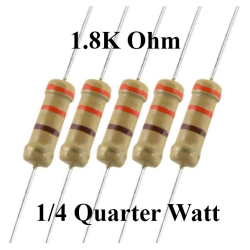
1. Four-color ring resistors
Four-color ring resistors refer to resistors that use four color rings to indicate resistance, counting from left to right, as shown in the figure. The first color ring indicates the largest digit of the resistance; the second color ring indicates the second digit of the resistance; the third color ring indicates the number of times the resistance is multiplied; the fourth color ring indicates the allowable deviation (accuracy) of the resistance.
For example, if the first ring of a resistor is red (representing 2), the second ring is purple (representing 7), the third ring is brown (representing 10 times), and the fourth ring is gold (representing ±5%), then the resistance of this resistor should be 270Ω, and the error range of the resistance is ±5%.
2. Five-color ring resistor
Five-color ring resistor refers to a resistor that uses five color rings to represent the resistance, counting from left to right, as shown in the figure. The first color ring represents the largest digit of the resistance; the second color ring represents the second digit of the resistance; the third color ring represents the third digit of the resistance; the fourth color ring represents the multiplier of the resistance; the fifth color ring represents the error range.
For example, if a five-color ring resistor, the first ring is red (representing 2), the second ring is red (representing 2), the third ring is black (representing 0), the fourth ring is black (representing 1 times), and the fifth ring is brown (representing ±1%), then its resistance is 220Ω×1=220Ω, and the error range is ±1%.
3. Six-color ring resistors
Six-color ring resistors refer to resistors that use six color rings to represent resistance values. As shown in Figure 1, the first five color rings of the six-color ring resistor are the same as the five-color ring resistor, and the sixth color ring represents the temperature coefficient of the resistor. -
4. What are the advantages of through-hole resistors?
Strong component connection: Through-hole technology passes through the circuit board through physical leads and is soldered on the other side, forming a strong connection that can resist mechanical stress. This makes through-hole resistors an excellent choice for components that are subject to physical strain, such as connectors, switches, or large, heavy components.
Reliable performance at high temperatures: Through-hole components are generally more resistant to extreme thermal environments, which is beneficial for applications that operate in high-temperature environments or undergo significant thermal cycles.
Easy to prototype and debug: Through-hole components are generally easier to use for manual assembly, prototyping, or testing. They can be manually inserted and soldered, making it easy to debug or modify prototypes.
Enhanced testability: Circuit boards designed with through-hole designs inherently provide excellent testability. The lead ends of the devices in the through-hole board also act as test nodes, which enables efficient online testing because the test probes can easily access them from the bottom. This makes it easier and more efficient to diagnose and fix any potential problems.
