
WMS-060Z vs 212-1-06-003
| Part Number |
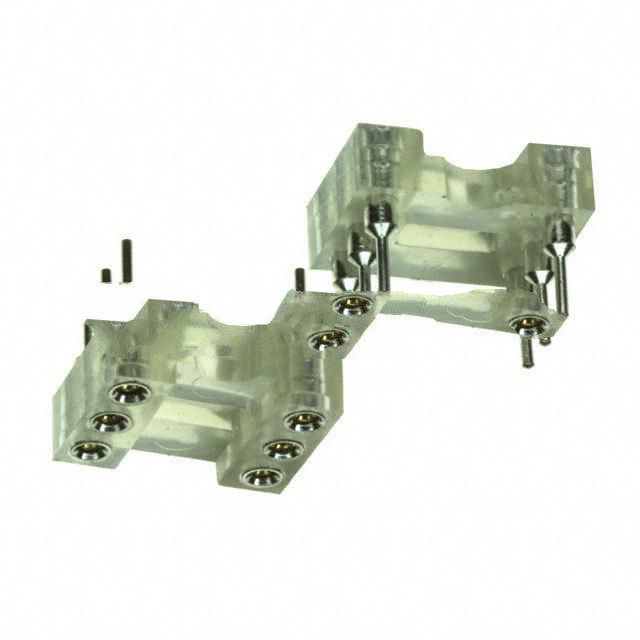
|
|
| Category | Sockets for ICs, Transistors | Sockets for ICs, Transistors |
| Manufacturer | On Shore Technology Inc. | CNC Tech |
| Description | CONN IC DIP SOCKET 6POS GOLD | CONN IC DIP SOCKET 6POS GOLD |
| Package | - | - |
| Series | WMS | - |
| Type | DIP, 0.3" (7.62mm) Row Spacing | DIP, 0.3" (7.62mm) Row Spacing |
| Features | Open Frame, Wash Away | Open Frame |
| Operating Temperature | -40°C ~ 105°C | -40°C ~ 105°C |
| Mounting Type | Through Hole | Surface Mount |
| Termination | Solder | Solder |
| Pitch - Mating | 0.100" (2.54mm) | 0.100" (2.54mm) |
| Contact Finish - Mating | Gold | Gold |
| Contact Finish - Post | Tin | Tin |
| Contact Finish Thickness - Mating | Flash | - |
| Number of Positions or Pins (Grid) | 6 (2 x 3) | 6 (2 x 3) |
| Contact Material - Mating | Beryllium Copper | Beryllium Copper |
| Pitch - Post | 0.100" (2.54mm) | 0.100" (2.54mm) |
| Contact Finish Thickness - Post | 200µin (5.08µm) | 200µin (5.08µm) |
| Contact Material - Post | Brass | Brass |
| Housing Material | - | Polybutylene Terephthalate (PBT) |
-
1. Does IC contain transistors?
IC (integrated circuit) does contain transistors. An integrated circuit is an electronic component that combines several microelectronic components such as transistors, diodes, resistors, capacitors, etc. on a tiny semiconductor chip. These components are usually manufactured on silicon wafers through semiconductor processes and can perform complex functions.
The role of transistors in ICs
Transistors play a key role in ICs. They are one of the basic building blocks of ICs. Transistors can amplify current or voltage signals and are the core components for realizing the functions of electronic circuits. By integrating a large number of transistors, resistors, capacitors and other components together, complex electronic circuits can be built to realize various electronic functions. -
2. Which IC package can be inserted into the socket?
DIP package (Dual Inline-pin Package) is an IC package that can be inserted into the socket. DIP package adopts dual inline form, and its number of pins generally does not exceed 100, which is suitable for small and medium-scale integrated circuits. This packaged IC has two rows of pins and needs to be inserted into a chip socket with a DIP structure, or it can be directly inserted into a circuit board with the same number of solder holes and geometric arrangement for soldering.
What is the use of transistors?
Transistors generally refer to all single components based on semiconductor materials. Transistors have multiple functions such as detection, rectification, amplification, switching, voltage regulation, signal modulation, etc. Transistors can be used for a variety of digital and analog functions.
On December 16, 1947, William Shockley, John Bardeen and Walter Brattain successfully created the first transistor at Bell Labs.
Transistors are one of the most critical components of modern electrical appliances. The reason why transistors can be used on a large scale is that they can be mass-produced at a very low unit cost.
-
3. What is the main function of transistors?
A transistor is an electronic device whose main function is to amplify and control current: the transistor is an important milestone in the development of electronic technology and is widely used in various electronic devices and circuits.
The basic function of a transistor is to amplify current. The three regions in a transistor are the collector, emitter and base. The voltage change between the base and the emitter can control the current between the collector and the emitter, thereby amplifying the current. When the current between the base and the emitter is small, the current between the collector and the emitter increases many times, which is the amplification effect of the transistor.
Transistors can also be used as electronic switches. When the current between the base and the emitter is small, the current between the collector and the emitter is basically zero, and the transistor is in the off state. When the current between the base and the emitter increases to a certain extent, the current between the collector and the emitter increases sharply, and the transistor is in the on state. This switching characteristic can be widely used in digital circuits to realize the function of logic gates. -
4. What are PNP and NPN transistors?
PNP and NPN transistors are two basic types of transistors, which have significant differences in structure and current flow direction.
Definition and structure
NPN transistor: It is composed of two N-type semiconductor regions sandwiching a P-type semiconductor region, forming three main regions of emitter (E), base (B) and collector (C). This structure makes the NPN transistor behave in the circuit similar to two PN junction diodes connected back to back.
PNP transistor: It is composed of an N-type semiconductor material doped between two P-type semiconductor materials, and also has three regions of emitter, base and collector, but the current flow direction and carrier type are opposite to those of NPN.
Working Principle
NPN transistor: When a forward bias voltage is applied between the emitter and the base, the free electrons in the emitter can cross the PN junction into the base and recombine with the holes in the base to generate a base current. A reverse bias voltage is applied between the collector and the base to prevent further flow of current. When a small input signal is applied to the base, this signal changes the voltage between the base and the emitter, thereby affecting the injection of free electrons in the emitter and forming a collector current. Since the collector current is an amplification of the base current, the NPN transistor has an amplification effect.
PNP transistor: The working principle is similar to that of the NPN type, but the current flow direction and carrier type are opposite. Positive charge flows from the emitter of the P-type semiconductor to the base, a part of which is captured by the base electrons of the N-type semiconductor and becomes the base current, and most of the rest becomes the collector current.
